
Gaussian Mixture Models: Finding Groups That Overlap
Published:
Imagine a map with a dot for every person in a park. Some people gather near a café; others gather around a playground. Most are easy to place in one crowd. Someone standing between the two is harder to assign.
A Gaussian mixture model, or GMM, describes a pattern like this using several overlapping clouds of points. It can give each point a probability of belonging to each cloud. This makes uncertain assignments visible.
Updated October 19, 2026. No equations or coding experience needed.
What is a Gaussian cloud?
A Gaussian distribution is the familiar bell curve: values near the center are common, and values far from it are less common. On a map with two coordinates, imagine looking down on a smooth hill. Its contour lines can form circles or ellipses.
A GMM combines several of these hills. Each component has three things to learn:
- A center: where the cloud sits.
- A spread and direction: how wide it is and whether it stretches along one direction. These are described by its covariance.
- A weight: how much that component contributes to the whole dataset.
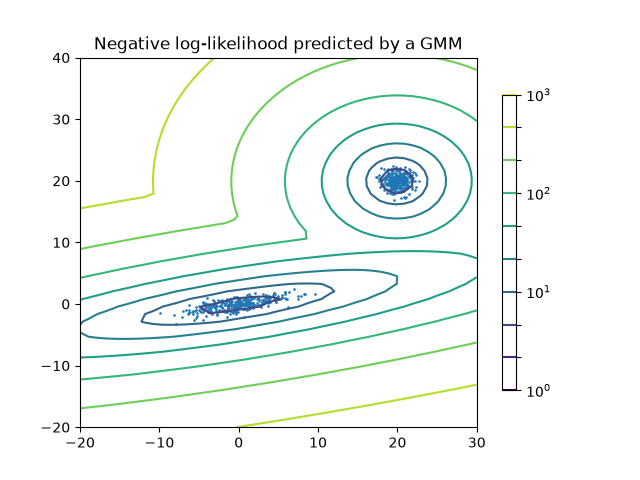
Each component still has a simple shape. A single Gaussian cannot follow a ring or a winding stream. Several components can approximate a more complicated distribution, but then one component may no longer mean one physical group.
How does it learn the groups?
The algorithm must estimate both the clouds and their memberships. It usually does this by repeating two steps, a procedure called expectation maximization, or EM.
- Make a starting guess. Choose a number of components and initial centers, shapes, and weights.
- Estimate membership (the E step). For each point, calculate how strongly each component explains it. A point might receive probabilities of 80% for one component and 20% for another.
- Update the clouds (the M step). Recalculate their centers, shapes, and weights using those probabilities. A point assigned 80% to a component contributes more to that component’s update than one assigned 20%.
- Repeat. Continue until the improvement becomes small enough to stop.
The points never move. The model’s description of them changes. Different starting guesses can produce different fits, so it is worth trying several initializations. The GMM documentation explains this fitting procedure.
What does an 80% membership mean?
It means that, under the fitted model, the point is more consistent with one component than the others. The probabilities across components add up to 100% for that point. This is called soft clustering.
For example, a point near the overlap between two clouds might receive 55% and 45%. Keeping both numbers preserves the ambiguity. If you need one label, you can choose the component with the larger probability.
These probabilities do not prove that the model’s groups are real. Even a point far from every cloud can strongly prefer one component relative to the others. A standard GMM has no separate noise category. Outliers can also affect the fitted clouds, so membership confidence and overall fit are different questions.
When is a GMM useful?
A GMM is useful when overlapping, roughly elliptical clouds are a reasonable description of the data, or when membership uncertainty matters. For example, it can help describe overlapping populations in a diagram of galaxy properties. Whether those components represent distinct physical populations requires additional evidence.
- Try more than one number of components. In an ordinary GMM, you choose this number. The Bayesian information criterion, or BIC, is a score that balances fit quality against model complexity; it is a guide, not proof of the true number of groups.
- Inspect the fitted shapes. A visually neat division can still be a poor description of a curved or irregular structure.
For irregular groups separated by sparse regions, a method based on local crowding may be more suitable. The companion post explains DBSCAN, OPTICS, and HDBSCAN.
Further reading: Gaussian mixture models and choosing the number of components, from the scikit-learn documentation.